financial-aid-forms choosing-schools
"We Make Too Much for Aid." Right, Wrong.
"We make too much for aid" is a guess standing where a number should be. What your SAI really tells you, and how it should shape your kiddo's college list.

Ten Myths · No. 1 of 10
What's in here
About a 14-minute read. It's built to be come back to, not read once — jump to what you need.
A dad said this to me in June. Nice guy, two kids, engineer, the kind of person who reads the manual before assembling the furniture.
And he had done the work. He and his wife had sat down, argued about it on and off for a few weeks the way couples do, and landed on an actual number — what their family could put toward one year of college without threatening their retirement or mortgaging their daughter's twenties. Their College Number.
That's the hard part. Most families never get that far.
So he'd cleared the hard part. Then he arrived at step two, which is the question every family asks next:
"Okay. Are we going to get any aid?"
And here's what he said.
"Michael, I've run the numbers. We make too much. Aid isn't for families like us. Why would I spend a Saturday filling out a form so a computer can tell me no?"
Gosh, I've heard some version of that a hundred times. And I want to be careful here, because that sentence is not stupid. It's not lazy. It's a reasonable conclusion drawn from everything this country has ever told him about paying for college.
It's also, by my rough count, the single most expensive sentence in this entire business — and not for the reason you'd expect. The cost isn't the aid he might have gotten. The cost is the list his daughter is about to build without it.
Right, wrong. Let me show you why.
Why you believe it — and why that's not your fault
Here's the asymmetry nobody names. Sticker prices are published. Your family's price is not.
Every college in America will tell you what it costs. It's on the website, it's in the mailer, it's the number your kiddo's friend's mom quoted at the soccer game. $95,000 a year. $78,000 a year. Big, round, terrifying, and findable.
What's not findable is what you will pay. And here's the part that makes people a little crazy when I walk them through it: the formula isn't a secret. It's federal law. The Department of Education publishes the entire thing — the assessment rates, the allowances, the tables, all of it — free, online, downloadable by anyone this afternoon.
So the method is completely public and families still can't get to their own number. That's a strange kind of hidden, and it's worth being precise about why, because "they hide it from you" is the easy answer and it's not the right one.
In practice, I meet parents in one of three places.
Some have never heard of the Student Aid Index. It's the figure colleges use to decide what your family can pay, it replaced the old EFC, and in four years of school events and mailers nobody has said the words to them once.
Some have heard of it and have no idea how to get theirs. They know a number exists. They don't know what produces it, which year's income it runs on, or who to ask. So it stays an abstraction — a thing that happens to you in April.
And some — this is the group I worry about — went looking, found a college's Net Price Calculator, ran it, and believed the answer.
I'd be careful there. A 2019 study out of Penn found colleges "providing inaccurate and misleading information" through those calculators. And it doesn't get better when the real paperwork arrives: the GAO examined actual financial aid offers and found an estimated 91% of colleges either leave the net price out or understate it — 41% omit it entirely, 50% state it too low, often by counting loans as though borrowing were aid.
So a parent does the only arithmetic available to them. Big scary published number, versus a household income they know by heart. Income looks big. Number looks bigger. Conclusion: we're on our own.
That's not a failure of intelligence. That's a rational response to a system that publishes one half of a subtraction problem and hides the other.
And the system, I'd gently point out, benefits from you reaching that conclusion. A family that self-eliminates costs a college nothing.
What that sentence is actually missing
"We make too much."
Too much for what?
I'm not being cute. That sentence is missing its second half, and the second half is where all the money is. It's like telling me you're too tall. Well — too tall for what? A doorway? A fighter jet? A bunk bed? "Too tall" isn't a fact about you until something is standing next to you to be too tall for.
Financial need is not a vibe. It's a subtraction problem, and it looks like this:
Cost of Attendance − Student Aid Index = Potential Need
Read that last phrase carefully, because this is where most explanations of the FAFSA quietly lie to you.
Not need you will receive. Potential need. Cost of attendance is the school's number. Your SAI is your number. What's left over is the size of the hole — and whether anybody fills it is an entirely separate question that depends on which school you're standing in front of.
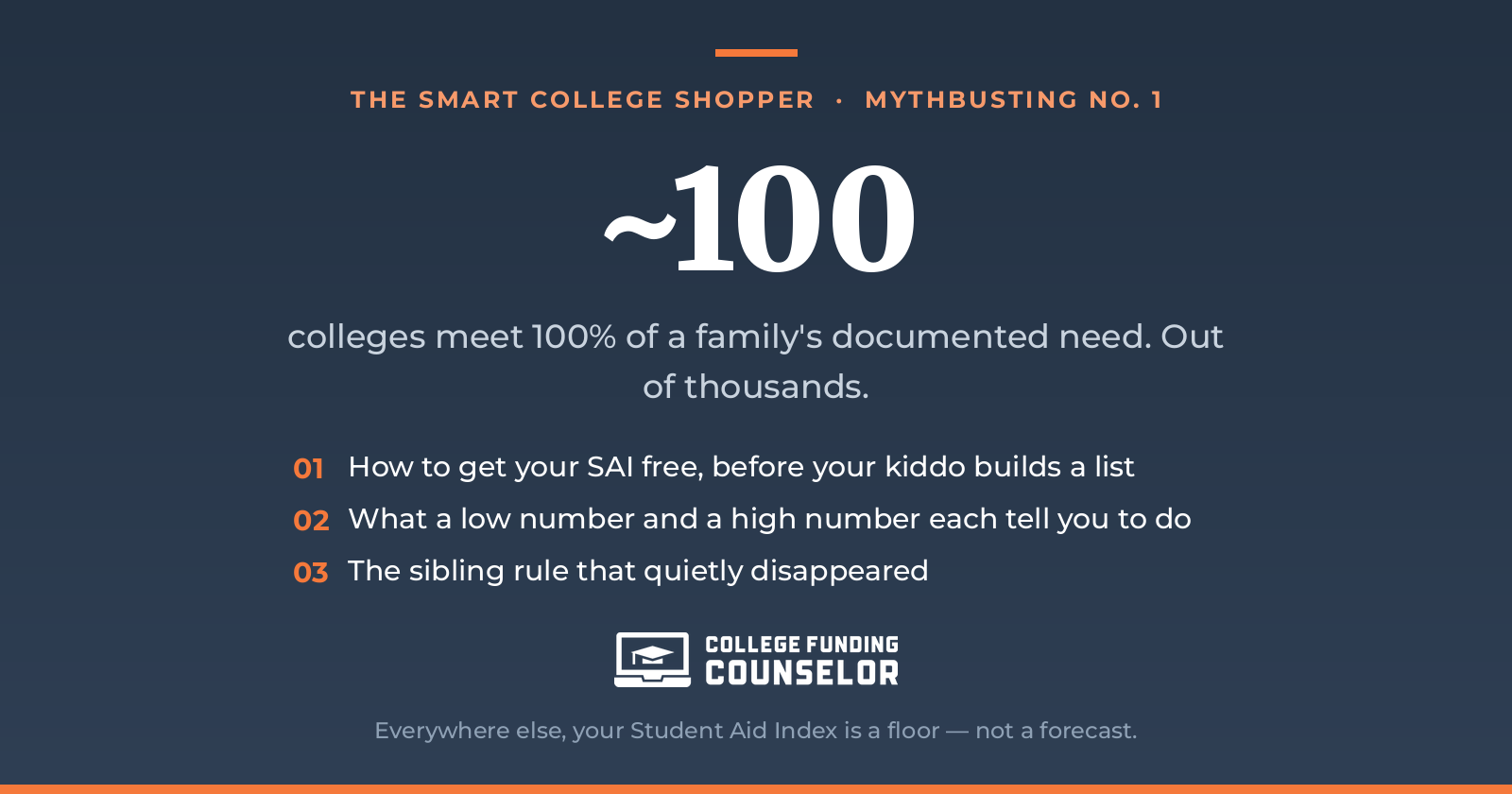
There are roughly a hundred colleges in this country that commit to meeting 100% of a family's documented need. A hundred. Out of thousands. Most schools do not fill the hole. They fill some of it, or a little of it, or they hand you a loan and call it aid.
So here is how I'd have you hold your SAI, and it's not how you'll see it described anywhere else:
Your SAI is the floor. It is the minimum you will pay, for one year, for one student.
Not the estimate. Not the likely number. The minimum — the number below which no school is obligated to go, before we even ask whether they'll come down to meet it.
Say your SAI comes back at $60,000. At a state school costing $28,000 a year, that's the whole bill and then some — you're full freight, and no formula is going to help you. At a private university costing $95,000, you have $35,000 of potential need, and now the real question starts: does this school meet it? All of it? With grants, or with loans dressed up as a package?
Same family. Same income. Same form. Wildly different answers, and the variable is the school — which is the whole argument I made a few weeks back about generosity. Generous isn't something a college is. It's a relationship between one school and one family.
So how do you actually get the number?
Two honest paths, and I want you to know about both.
The free one. The Department of Education runs the Federal Student Aid Estimator at studentaid.gov. It's free, it takes a few minutes, and it will hand you an SAI estimate. Its own documentation is careful to say the tool "is not an aid application and students will not receive any aid without submitting a FAFSA form." Fine. You're not trying to collect aid this afternoon. You're trying to learn a number.
The paid one. There is purpose-built college funding software that models your SAI against specific schools and puts merit money alongside need, school by school. It costs real money, though not very much of it, and it does things the free estimator does not. I use tools in that category with my own clients.
Either way — get the number before your kiddo builds a list. Not after.
And here's what that number tells you, in both directions.
Say it comes back low. Twenty thousand dollars, or under. On paper that reads like good news, and at the right school it genuinely is — you have enormous potential need.
But potential need is only worth what a school decides to fill. At a school that isn't generous with need, a low SAI isn't a discount. It's a fifty-thousand-dollar-a-year hole with nobody standing in it. Those schools aren't "a stretch." They're unaffordable, and wanting it badly does not change the arithmetic.
The one real exception is a kiddo with a genuine shot at a significant merit award. And "genuine shot" means you have looked up what that school has awarded in recent years, and to what share of its freshmen — not that a counselor said she's a strong applicant. More on what those published numbers can and can't tell you in a moment.
Now flip it. Say it comes back at eighty-five thousand or more. That feels like the bad news. I'd argue it's the most freeing number in this entire business.
Because you are now finished with a whole category of worry. You're not getting need-based aid, so you can stop wondering whether you will. And you never have to hold your breath over the thing that quietly wrecks families in year three — a raise in your kiddo's sophomore year that shrinks the award and turns a school you could afford into a school she has to transfer out of. I have watched that happen. It is brutal, and it is avoidable, and a high SAI makes you immune to it.
Your job just simplified to one question: which schools have been generous with merit, and how generous?
And I have to be straight with you about the limits of that question, because this is where a lot of people — including people who should know better — will hand you a false certainty.
What you can look up is history. Every school publishes what it did last year: how many freshmen received merit money, and what the average award was. You can average a few years to smooth out the noise. That is genuinely useful and it's the best information available to anyone standing outside the building.
It is not a guarantee. It's a projection.
Schools change. A class comes in over-enrolled and the discount tightens. A new president decides to chase a different kind of student. The endowment has a bad year. "Thirty-seven percent of freshmen, averaging $30,000" tells you what a school has tended to do, and tendencies are absolutely worth planning around — but the only people who know what a school will do this year are the ones setting the policy, and unless you're married to a director of admissions, that isn't you or me.
So you plan with a margin. You use the published numbers to sort schools into "has been generous to families like ours" and "has not" — a real and genuinely useful sort — and then you build a list that still works if the award lands under the average. That's not pessimism. That's what planning looks like when you're working from a projection instead of a quote.
Even so, it beats praying for a need-based award that was never coming.
And the other half of that answer, which nobody wants to hear and which I'm going to say anyway: a high floor is information about price, not a verdict on your kiddo. There are a great many very good schools in this country that cost a great deal less than $95,000 a year. A high SAI is the clearest possible signal to go look at them — not later, not as a backup, but as real candidates on the list you build this fall.
Refusing to calculate the number doesn't make it go away. It just means you're the only person in the negotiation who doesn't know it. The colleges know how this works. The counselors know. The formula is public.
You're the one operating blind, and you chose it on a Saturday morning to save two hours.
The rule that changed while nobody was looking
Now here's the one that gets me, because it cuts the other way.
For decades, the aid formula divided your expected contribution by the number of kids you had in college at the same time. Two in college, half the number each. NASFAA's own example: a family with a $10,000 expected contribution and twins in college saw each twin assessed at $5,000.
That was the good news buried in the terrifying news. Yes, two tuitions at once. But the formula was going to meet you partway.
That rule is gone. The FAFSA Simplification Act removed it, and the language is unambiguous:
"The new formula does not take into account a family's number in college, neither in this final step of the calculation nor in the Income Protection Allowance."
Not reduced. Not phased down. Removed, in both places it used to live.
I have twins. So when I tell you that families plan around that halving rule, I'm telling you something I understood from the inside long before I did this for a living. It was the one piece of arithmetic that made two-at-once survivable on a spreadsheet.
And I still meet parents in 2026 — smart, engaged, doing their homework — who are budgeting against a rule that stopped existing. They read it in an article, or a well-meaning uncle told them, or they remember it from an older kiddo's cycle. Nobody sends a letter when a rule changes either.
If you have two heading to college together and you've been counting on the split, you need to re-run your numbers. Today, not in April.
Build the list around the number, not the other way around
Three numbers run this entire thing, and you've now met two of them.
Your College Number is what your family can genuinely put toward one year of school without threatening your retirement or your kiddo's first decade of adulthood. You decide it. Nobody hands it to you, and no formula produces it. I walked through the four inputs here.
Your SAI is the floor — the minimum the schools and the federal government expect you to pay, for one year, for one student. The formula decides it, and the FAFSA is how you find out what it says. Full walkthrough here.
The gap between those two numbers is what should be running your kiddo's college list.
Because a college list is not a wish list. It's a budget with names attached to it.
Say your College Number is $30,000 and your SAI comes back at $60,000. You now know something enormous before anybody books a campus tour: at any school that doesn't award generously to a family like yours, you are $30,000 a year short. Times four. That is not a reason to give up — it's a reason to be ruthless about which twelve schools go on the list, because a few of them will close that gap and most of them will not. Telling those apart is what last week's post was about.
Here's the trap, and it's the one I most want you to avoid.
A family skips all of this and lets their kiddo choose from the entire universe of American colleges, ranked by feeling. Then they tour. Then she walks across a quad on a gorgeous October afternoon, and she falls in love.
And now you have a problem arithmetic cannot solve, because it stopped being about arithmetic the moment she fell in love.
Then the award letter comes. It's late March. She got in — she got in! — and the offer is $30,000 a year short.
And now I get to have the worst conversation in my job.
"So what do we do now?"
Now. In March. With a deposit deadline on May 1, a daughter who has already told everyone she knows, and a list where every other school was picked by the same feelings that picked this one.
There are exactly two doors left at that point, and I have watched families walk through both of them.
Door one: you pay it anyway, out of your future. You stop funding retirement for four years. You borrow at 55. I have sat across from parents in their sixties still writing those checks, and not one of them has told me it was worth it.
Door two: you hand it to your kiddo. A 22-year-old starts her first job carrying payments that run ten or twenty-five years, on a starting salary, before she has rented her first apartment. That's a mortgage without a house.
There's a third door, and nobody offers it to you. You look at these numbers in junior year, while the list is still a list and not a set of hopes with a kid attached. You put schools on it that can actually get you where you need to go. Your kiddo still falls in love — with a school that will have her, at a price your family can pay.
The difference between those two outcomes is a few hours of work — done in September, instead of discovered in March.
That's the whole job.
One thing I'd rather you hear from me
You can do all of this yourself.
The estimator is free. The federal formula is published. The Common Data Set for every school on your kiddo's list is a public document, and section H2A will tell you what that school awarded in merit money last year and to how many freshmen — with all the caveats above about history not being a promise. An organized parent who starts in junior year, with a legal pad and a couple of focused evenings, will get most of the way there without paying anyone a dollar. I mean that, and I'd rather say it out loud than have you discover later that I left it out.
And while we're here, let me kill a myth that's adjacent to this one and works in my industry's favor: filling out the FAFSA is not hard. It used to be. It was restructured in 2024, it's dramatically shorter, and it pulls your tax data in automatically. If somebody is offering to complete the form for you as their service, you are paying a few hundred dollars for typing.
And I'll be straight about my own practice, since it would be easy enough to catch me out on this one: I do fill out the forms for the families I work with — FAFSA and CSS Profile both — and I'm glad to. It saves them an afternoon and it means the answers are right the first time. But that comes along with the strategy work. It is not the reason to hire anybody. If form completion is the whole offer, it isn't worth what it costs.
The hard part was never the form. The hard part is everything in this post — the budget conversation, the number, the gap, and the strategy decisions that follow from it. Which schools go on the list and which come off. Where merit is realistically winnable and where it isn't. Whether the list your kiddo built in the spring survives contact with the arithmetic, and how you have that conversation with her without it becoming a fight.
One exception to "the form is easy," and it's a big one.
Roughly 250 schools — mostly private, and often exactly the ones your kiddo is most excited about — require a second form on top of the FAFSA. It's called the CSS Profile, and it is a different animal entirely.
I've called it a 1040 on steroids before and I'll stand on that. It wants the medical and dental expenses you paid out of pocket. What you're spending on your other kiddo's schooling. Whether you own a second property and what it's worth. And home equity, business assets and a non-custodial parent's income — the three the federal formula leaves alone — all come back into play, school by school, on each school's terms rather than Washington's.
The FAFSA got easier in 2024. The CSS Profile did not.
So check whether anything on the list requires it, and check now rather than in December. If one does, budget an afternoon, not an hour. And treat my "roughly 250" exactly the way I asked you to treat merit averages — the list moves year to year, so verify the schools you actually care about rather than trusting any published count, mine included.
And some families should not be doing this alone.
If you're separated or divorced and running two households. If you're remarried with children from a previous marriage. If you're widowed. If you own a business. If your situation involves an inheritance, a trust, or real estate beyond the house you live in.
In every one of those, the forms ask questions that do not have one obvious answer — and the answer you choose changes the number. That's the honest shape of it, not a pitch. Those families should talk to somebody before they file, whether that's me, a school counselor, or someone else who does this work for a living. It is far easier to get right the first time than to unwind afterward.
That's the work. That's what a college funding specialist is actually for. Not the data entry.
The number exists either way
That dad in June hadn't run his number. We talked again in August, and he did.
I don't know yet what it will say. Neither does he. It might come back and confirm exactly what he assumed — that his family pays close to full freight most places, and this whole exercise bought him nothing but an evening and some certainty.
That's a real possible outcome and I'm not going to pretend otherwise.
But it also gave him something in August that he could not have bought in March: a list built on arithmetic instead of hope, and a daughter who is going to fall in love with a school her family can actually pay for.
The number was always there. It was there in June when he was sure he knew what it said. It did not care whether he looked at it.
Refusing to open the envelope doesn't change what's in the envelope.
Don't walk this path alone.
Next in this series: the form that produces this number is already open — quietly, ahead of its October 1 launch — and what filing it gets you is more than most families think.