financial-aid-forms award-appeals merit-aid
Saying Yes Before You See the Price
Early Decision means saying yes before you see the aid offer. The two tests to pass first, what a real Plan B looks like, and what to ask the aid office.

The appeal came back in a few days. The answer was no.
Not "we can find you a little." Not "let's talk in the spring." No.
This family did almost everything right. Their son was a strong student and a good football player, and he was recruited to play at a highly selective private college, the kind of school that doesn't offer athletic scholarships and is hard to get into even with a coach in your corner. At schools like that, recruited athletes are generally expected to apply Early Decision. So the summer before senior year, he committed. Everybody was thrilled. He'd earned it.
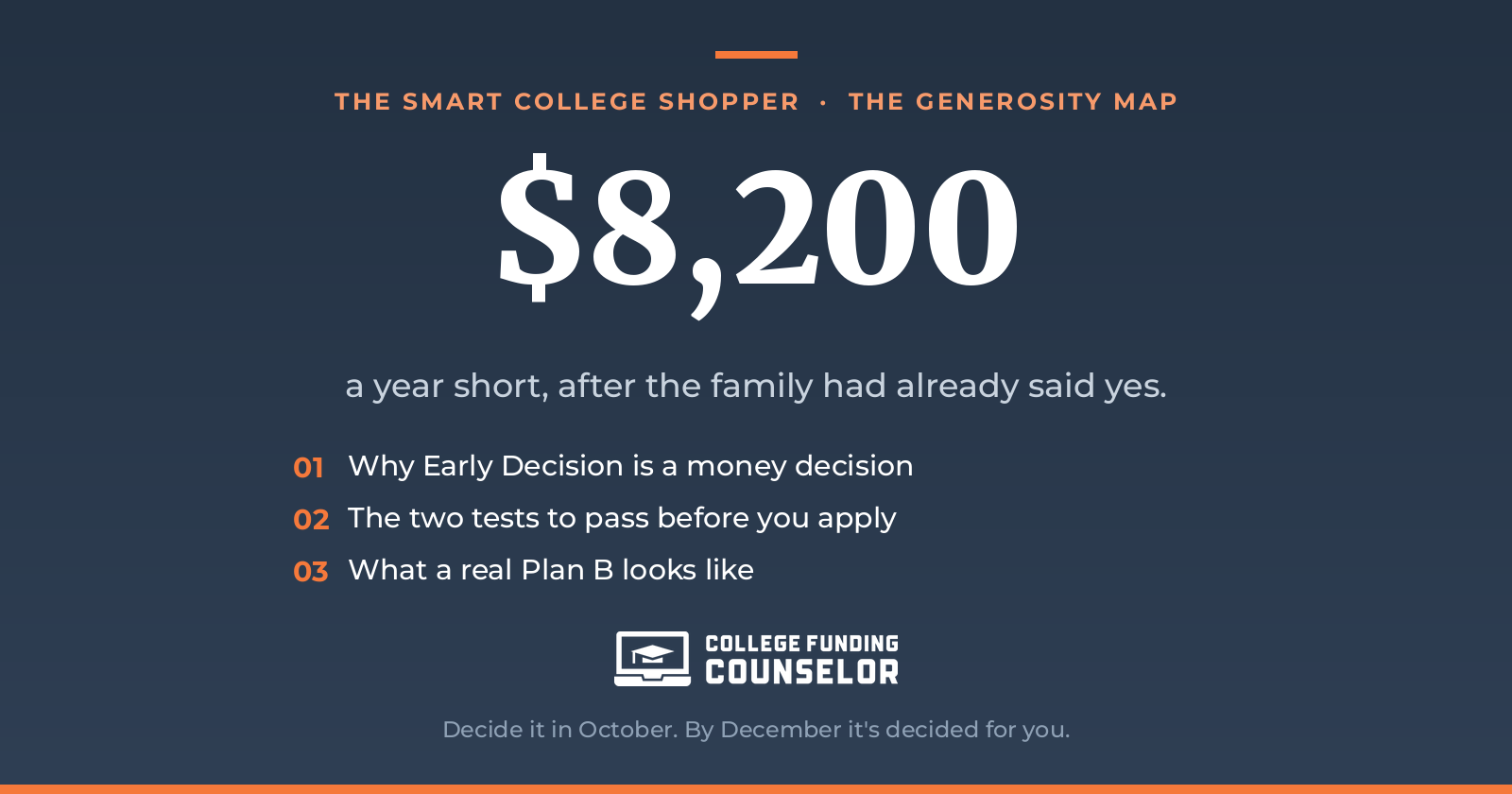
I met the family in October, when the financial aid forms opened. By then he'd been committed for three months. We ran three different estimates of what the school would cost them, including the school's own net price calculator, so we weren't leaning on any one tool. He was admitted in December, which is no small thing at that school. Then the aid offer arrived, and it was $8,200 a year below where our estimates had put it.
I coached his dad on an appeal. He wrote it and sent it in. A few days later the school replied, politely and firmly. Their son had been right on the line of qualifying for any need-based grant, and they'd already given him the benefit of the doubt in the first offer. Without a major change in the family's circumstances, that offer was the most they could do for year one. They'd look again next year, when his younger sibling starts college.
The family earns about $250,000 a year before taxes. They're now looking at roughly $80,000 a year out of pocket for one kiddo, in after-tax dollars. His dad took out a private parent loan to cover the gap.
I'm telling you this story because it didn't work. I want you to see exactly where it went wrong, because it went wrong at a moment that is coming up for a lot of you in the next six weeks.
Early Decision is a financial decision
Most families treat Early Decision as an admissions question. Is this our kiddo's first choice? Will applying early help them get in?
Those are real questions. But ED is also a money question, and it's the only point in the whole process where you're asked to answer the money question before you know the price.
Here's how it works, in plain English:
- You apply by an early deadline, usually November 1 or November 15.
- You hear back in mid-December.
- If your kiddo is admitted, they're committed to attend. They withdraw every other application. No comparing offers in April. No waiting to see who else says yes.
And you, the parent, often sign the agreement too. Vassar's ED agreement, which is typical, has a line for the parent that reads: "As the parent/legal guardian, I will ensure that the applicant abides by the Early Decision commitment outlined above."
That's your signature on a promise made before anyone has told you what the promise costs.
Early Action is a different animal, by the way. EA is early and non-binding: you apply early, hear early, and keep every option open until spring. Most of what I'm about to say doesn't apply to EA.
Think of it like waiving the inspection
If you've bought a house, you know how this goes.
In a hot market, a buyer who waives the inspection and the financing contingency gets the house. The seller loves that offer. It's clean, it's certain, it closes. And the buyer has agreed to close on a house before they know what's behind the walls.
Early Decision is a waived contingency. The college loves it for the same reason the seller does. It's certain, and certainty helps a college hit its enrollment targets. In exchange, your family often gets a better shot at admission.
That's a real trade, and sometimes it's a smart one. But it's a trade. You're giving up something with a dollar value in exchange for something with an admissions value. Families who treat ED as free are usually the ones who didn't notice they were trading anything.
How much better a shot? Look it up.
You don't have to take my word for any of this. Almost every college publishes a Common Data Set, a standardized report that's free on the school's website. Section C21 lists how many students applied Early Decision and how many got in. Here's what two highly selective schools reported for the class that entered in fall 2024:
| Williams College | Washington and Lee University | |
|---|---|---|
| Overall admit rate | 8.3% | 27.2% |
| Early Decision admit rate | 23.3% | 33.9% |
| ED admits, as a share of the entering class | about 46% | about 61% |
| First-years with no need who got merit aid | 0 | 18, averaging $59,826 |
Three things jump out.
The ED edge depends on the school. At Williams, applying ED nearly tripled the admit rate. At W&L, the bump was modest. Same strategy, very different payoff. And those ED numbers include recruited athletes and other students the school was already planning to take, so the edge for everyone else is smaller than it looks.
By the time Regular Decision opens, half the seats or more are spoken for. That's the pressure families feel, and it's real.
Merit changes what ED costs you. Williams gave merit aid to zero first-years. There, aid is need-based or nothing, which is exactly why a family right at the line of need has nothing else to reach for. W&L gives real merit money. Applying ED there means giving up the chance to compare merit offers in April.
One more line from the same reports: both schools say they meet 100% of demonstrated need. Both also found that 9% to 16% of the first-years who applied for aid had no need at all, by the school's math. "Meets full need" means need as they calculate it.
"But can't we get out of it if the money's not there?"
Boy, this is the first question I get. Every single time.
"Michael, if we apply ED and the aid is terrible, we can still say no, right?"
Well. Technically? Yes.
The standard ED agreement has a financial release. Here's the actual sentence, from the same Vassar agreement, and the same words appear in the Coalition application's version:
"Should a student who applies for financial aid not be offered an award that makes attendance possible, the student may decline the offer of admission and be released from the Early Decision commitment."
So the exit exists. Now read it one more time and notice two things.
First, who decides what "makes attendance possible"? The school. Not you. There's no published formula for it. A family that can technically come up with the money, painfully, with a loan and a rough year, is going to have a hard time arguing that attendance is impossible.
Second, and this is the one that matters: by December, nobody is using that clause.
Think about where your kiddo is emotionally the day that admission comes through. They've told their friends. They've bought the sweatshirt. In this family's case, the son had been committed to a team since July. He knew his future teammates. The coach knew him by name.
Nobody seriously considered asking to be released. I don't blame them one bit. The release clause is a legal exit. It is not an emotional one. When the aid offer came in short, the real choice in that house was never "attend or don't." It was "how do we pay for this?"
Which brings me to the two tests.
The two tests for Early Decision
I give every family considering ED the same two tests. Both have to pass. Not one. Both.
Test 1: Your kiddo is over the moon about this school
Not "it's a good option." Not "it's probably my top choice." Over the moon. Visited, researched, pictured themselves there, and would pick it over every other school on the list even if every other school said yes.
This family passed Test 1 without breaking a sweat. That kid was over the moon.
Most families who apply ED pass Test 1. It's the one they're thinking about.
Test 2: You have a Plan B if the aid comes in short
This is the one this family didn't have, and it's the one almost nobody builds.
Plan B means you decided, before you applied, what happens if the aid offer lands below your estimates. Not "we'll figure it out." A real answer, agreed on in advance, ideally with your kiddo in the room.
This is where it went wrong. The estimates were careful. Three of them, from three different sources. But careful estimates are still estimates, and this school made a judgment call at the margin that no calculator could see coming. That's not a flaw in the tools. It's what happens when a family sits right at the line of qualifying for need-based aid. Small differences in how a school reads your finances can swing the offer by thousands.
The estimates did their job. What was missing was an answer to the question: and if they're wrong?
What a Plan B actually looks like
A Plan B is one of these, decided before the application goes in:
- You can absorb the miss. Take your lowest estimate, then assume the real offer comes in several thousand dollars a year worse. Can you pay that without borrowing and without touching retirement? If yes, you have a Plan B. It's called "we'll pay it." That's a perfectly good plan. This is where your College Number earns its keep. It's your walk-away price, set before the emotion arrives.
- You've agreed, as a family, that you'll use the release. Out loud, in advance, with your kiddo. "If the aid offer is more than $X a year above our number, we ask to be released, and we go with the other schools." It's a hard conversation in October. It's close to impossible in December. Have it in October.
- You keep other applications alive. The standard agreement language says students applying for aid don't have to withdraw their other applications until they've received the ED school's financial aid notification. So submit your Early Action and rolling applications anyway. A Plan B you can't actually reach isn't a Plan B.
- You've borrowed on purpose, not by default. If your plan is to borrow the gap, fine. Decide how much, from where, and whose name is on it, before the offer comes in. That family did borrow, through a private parent loan. The difference between that and a Plan B is whether you chose the number in October or discovered it in December.
If none of those four is true for your family, Test 2 fails. And if Test 2 fails, I'd look hard at Early Action or Regular Decision, even for a school your kiddo loves.
Why the appeal had nowhere to go
I've written a lot of financial aid appeals, and plenty of them work. Here's why this one didn't.
An appeal works when you bring the school new information, like a job loss, a medical cost or a business year that looked great on paper and terrible in the bank account. That's what the aid officer's professional judgment authority is for. I wrote about how that process works in my post on the FAFSA.
This family didn't have new information. Their finances were what the school already saw. So the appeal was really asking, can you do a little better?
In April, in Regular Decision, that question can have teeth, because you're often holding another school's offer. Not always, and it's not a bidding war, but a real competing offer gives an aid officer something concrete to respond to.
Under Early Decision in December, you're holding nothing. There's no other offer, because your kiddo withdrew every other application. And the school knows your kiddo is coming.
It's about leverage. A lot of this is about leverage. ED is the moment you hand yours over.
The recruited-athlete wrinkle
If your kiddo is being recruited, especially at a Division III or Ivy-level school, read this part twice.
Division III schools don't give athletic scholarships. That's straight from the NCAA: "Division III schools do not offer athletics scholarships." The money at those schools is need-based and merit-based aid, the same as every other student gets. A roster spot doesn't come with a check.
At the same time, recruited athletes are often expected to commit early, sometimes months before the application is even due, and to apply ED. That's what happened here. The commitment was made in July. The financial picture came into focus in December.
So here's the step I most want recruited families to take: ask for an early financial aid estimate before your kiddo commits. Some selective schools will run one for recruits. It's often called a financial aid "pre-read." Cornell's financial aid office, for example, says plainly that it "provides early financial aid estimates to recruited athletes upon request by Cornell Athletics." You typically submit the CSS Profile and your tax return early, and you get back something much closer to a real number than any calculator.
Not every school does this, and the process usually runs through the coach, not the financial aid office. So ask the coach directly: "Before we commit, can we get an early read on financial aid?" A coach who wants your kiddo has every reason to help you get that answer.
This family didn't get a pre-read. I'd bet money that most recruited families don't know to ask.
A little hope for year two
The school's reply did end on something real: they'd look again next year, when the younger sibling starts college.
The FAFSA stopped giving families a break for two kids in college at once starting in 2024-25. But many schools that use the CSS Profile, their own more detailed aid form, still factor it in. This school told the family, in writing, that the second enrollment should raise his eligibility significantly.
Will it? Nobody knows until the offer comes. Treat any promise about next year as a hope, not a plan.
When Early Decision is the right call
I'm not anti-ED. For some families it's the right move. It tends to make sense when:
- Need-based aid doesn't matter to you. If you'd pay full price at this school without borrowing and without touching retirement, there's nothing to compare. You're not giving up leverage you would have used. Apply ED and enjoy your December.
- You've got a real number in hand. An early aid estimate, a pre-read, or estimates you trust with room to spare below your College Number.
- Your kiddo passes Test 1 and your family passes Test 2. Both.
It tends to be a mistake when:
- Your estimates put you right at the line of qualifying for need-based aid, like this family. That's exactly where offers swing the most.
- Comparing merit offers in April is the whole strategy.
- Nobody's willing to have the Plan B conversation. That's the tell.
Questions to ask the financial aid office before you apply
Call them. Ask these. Write down the answers and who gave them to you.
- Will we see our full financial aid offer before the binding deadline?
- If the offer doesn't make the school affordable for us, what's the process for release? How do you decide what "affordable" means?
- How closely does your net price calculator track what ED admits actually receive? When does it miss?
- Are ED admits considered for the same merit scholarships as Regular Decision applicants?
- Can ED admits appeal? Is the process or timeline any different?
- What documents should we send early to get the most accurate offer?
You don't need me to make that call. The questions are free, the phone call is free, and most aid officers will give you a straight answer if you ask a straight question. Plenty of families do this homework themselves and do it well.
Where I'm useful is in reading the answers against your actual numbers, and in having the Plan B conversation with you before the application goes in, when it's still an easy conversation.
What I'd tell that dad now
He wrote me a gracious note after the appeal was denied. He was disappointed. He thought they'd been naive with their first kid, and he felt the football timing had pushed them to commit before the money was clear. He's not wrong about the timing.
But I'd push back on "naive." They were careful. They ran more estimates than most families run. The kid did the hard part, getting into a very hard school, and he's playing college ball.
What they didn't have was an answer to "and if the numbers are wrong?" And I'll own my share of that. By the time I met them in October, the commitment was three months old, and I put my energy into getting the estimates right. The Plan B conversation should have happened anyway. It's the one I have with every family now, before anything else.
That's the question. Ask it before you sign. It costs you nothing in October. By December, the cost is whatever the offer says.
Don't walk this path alone.